DMS Talks
From Large Language Model to ROI.
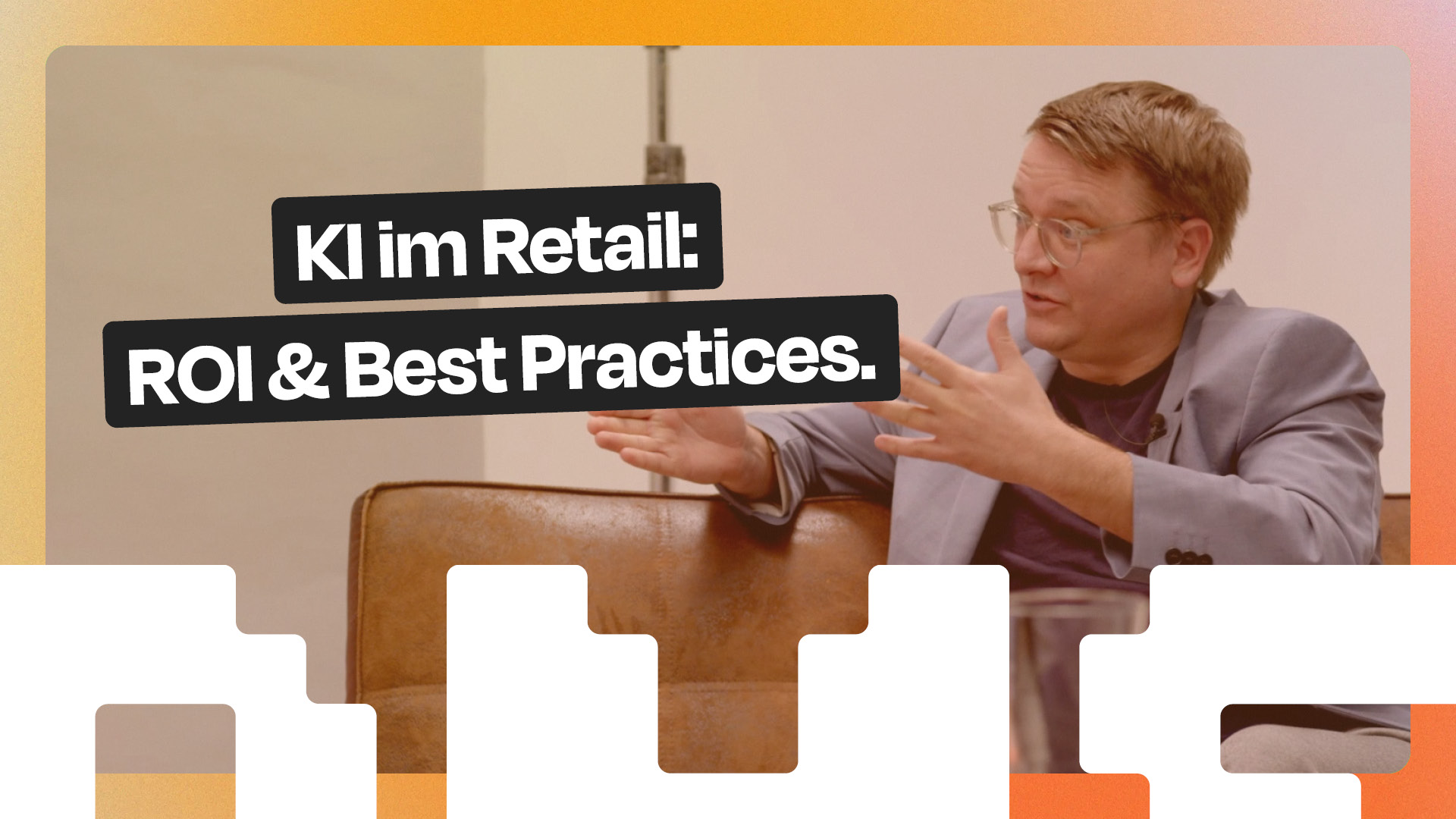
More Modern Talking About the Potential of Artificial Intelligence in Retail
How does a large language model become real added value? At the end of his retail.ai roadshow, Norbert Hillinger and Oliver Nitz, CMO of DMS, discussed ideas and innovations in retail.
Her conclusion: With in-depth insider knowledge of AI, retail is becoming smarter and more successful.
Hype Versus Reality — What Is the Point of Megatrend AI?
“Technologies are developing faster than companies can adapt them. You have to keep an eye on the Martec Act.”
— Reality check by Norbert Hillinger
Versatile in Use — And Always Wow: AI in Retail
From procurement to customer contact, AI is proving its value across the entire retail value chain. Take “Nelson,” Deutsche Telekom’s AI-powered purchasing bot — it autonomously negotiates purchasing conditions, demonstrating how AI is reshaping procurement. In Category Management, AI analyzes sales data and delivers precise recommendations for action.
Beyond analytics, AI is already driving efficiency and innovation in key areas such as customer service, marketing, store design, checkout, and payment solutions. In short: AI is optimizing every touchpoint in the retail journey.
Success Stories — Powered by AI
AI is delivering measurable impact across the retail sector. These standout examples from the DMS Talk showcase how artificial intelligence drives real results:
- Klarna – Around two-thirds of customer interactions are handled by AI, saving the Swedish payment provider the equivalent of 700 full-time jobs.
- DM Drugstore – With the custom-developed DM GPT model, over 1,000 employees are already benefiting from more efficient internal communication.
- Deutsche Telekom – The AI procurement bot “Nelson” optimizes purchasing processes.
- IKEA, Hofer & more – Location analytics powered by AI help analyze massive volumes of GPS and stationary data to better understand customer behavior, target groups, and store visit frequencies.
Whether it’s creating a web shop with AI-based tools, automating product descriptions and video content, or using AI for content scoring (like “eye tracking by a machine” to assess vividness and clarity of advertising) — AI offers limitless potential.
About the Responsible Use of AI
While AI unlocks new opportunities in retail, responsible use is essential.Models must comply with data protection regulations, and retailers must stay alert to the risk of reinforcing bias through AI systems. Companies should train their teams to use AI ethically and thoughtfully.
Even More Modern Talking: Always New, Always Exciting — The DMS Talks
Want to go deeper? Our webinars feature insights from industry insiders like Luis Knoke (MUSE Content) and Rainer Will (Trade Association) — and the next DMS Talk editions are already in the works! Our mission stays the same: Inspire. Innovate. Share insider knowledge that helps retailers move forward.
Looking for support? We’re here to develop custom digital solutions tailored to your business — from Digital Signage to Location Analytics and more — powered by AI.
Please note: this DMS Talk is available in the German language only.
Read the full DMS Talk transcript
DMS Talk – From LLM to ROI
Using AI in Retail and Consumer Goods
Oliver Nitz (DMS):
Welcome to our DMS Talk – I believe this is already the tenth one.
From LLM (Large Language Model) to ROI (Return on Investment): Using AI in Retail and Consumer Goods.
A long title – and the key question: Generative AI – higher, faster, further?
AI now affects nearly every value chain. Where do we stand today? AI has become indispensable in many workflows. But what about tangible performance and practical solutions? What can we actually use it for?
We’ll explore these questions today – together with my guest.
My name is Oliver Nitz, I’m with DMS and I’ll be your moderator today.
We at DMS have been active in retail for 20 years, expanding physical spaces with digital solutions – primarily digital signage, frequency and motion analytics, and much more. That’s exactly where we use AI: to analyze large data volumes and help clients make informed decisions.
Please welcome Norbert Hillinger, AI & Retail Associate at Retail AI GmbH.
A long title – what does “AI & Retail Associate” actually mean?
Norbert Hillinger (Retail AI):
Thanks for the invitation, Oliver. I’ve been working with Retail AI for a few months now. As an AI & Retail Associate, I get to look across departments within the corporate startup and, after a sort of trial phase, focus where I can deliver the most value.
As a trend and futures researcher with lots of training experience, I find it particularly exciting to see how generative AI is taking effect in retail. And yes – I fully expect to “extend my stay.” AI is here to stay.
Who is behind Retail AI?
Oliver:
What exactly are you working on?
Norbert:
Maybe a step back: Behind Retail AI is the Markant Group (Switzerland) – known in retail as a platform connecting manufacturers and retailers (offering pricing, payment, and inventory services, among others). Markant acts as a technical service provider – not logistics from A to B, but the digital/technical infrastructure behind it.
To address artificial intelligence, Markant founded a corporate startup – Retail AI, based in Frankfurt (launched early 2024). We’re still small (<10 employees) and work across four pillars:
- Product Factory – develops AI applications, especially generative AI for retail and consumer goods, ideally built on the Markant platform.
- Labs – a “sandbox” for cross-innovation with other startups (e.g. combining AI with AR/VR, blockchain, etc.). Innovation often happens at the intersections.
- Alliance – a think tank or safe space where practitioners (from the DACH region) exchange experiences with AI (challenges, opportunities).
- Academy – focuses on upskilling and workforce transformation: training programs to build AI competence within organizations.
We’re not non-profit – the goal is to learn, build, bring to market, and thus create both value and business.
Hype or Substance?
Oliver:
AI is influencing every value chain. Where do we stand – and what actually works today?
Norbert:
AI itself is old – but generative AI at this scale is very new. Since late 2022 (with ChatGPT), the pace of innovation has been enormous. Many refer to the Gartner Hype Cycle – expectations are sky-high. A reality check is important: not everything that’s demonstrated is already robust. Yet we often underestimate how much becomes possible in a short time.
A practical tip: AI directories (such as There’s an AI for That) list thousands of tools – with new ones emerging daily. In retail, there are use cases along the entire value chain.
Examples Across the Value Chain
Norbert:
- Procurement: Negotiation bots (e.g. “Nelson” at Deutsche Telekom) conduct purchasing dialogues on terms and conditions.
- Category Management: With generative AI, you don’t just ask “How’s butter performing in Eastern Austria?” – you also get actionable insights (“Sales +6%, but Kerrygold weaker – suggested actions …”).
- Store & Checkout: Computer vision and sensors enable self-checkout and “pick & go” concepts (à la Amazon Go).
- Marketing/CRM: Personalized content, AI chatbots for service and consulting, content generation (text/image/video/audio), live-shopping automation.
Service & Chatbots – Threat or Opportunity?
Oliver:
Customer service: There are smart bots – but sometimes people just want to talk to people.
Norbert:
Both are valid – it’s a question of values and strategy.
Klarna is a standout example: its bot handles about two-thirds of all inquiries with comparable quality, but much faster – equivalent to hundreds of FTEs and saving tens of millions annually.
Other companies deliberately focus on human excellence (like Tony Hsieh’s legendary Zappos example). What matters is alignment with the brand.
Internal AI: Unlocking Knowledge, Staying Secure
Oliver:
What’s happening internally – beyond website bots?
Norbert:
A huge topic. Many organizations are building internal LLM assistants (“copilots”) trained on their own data: intranet, manuals, reports, knowledge bases.
Example: dm drogerie markt uses an internal model with several thousand users and tens of thousands of prompts.
Possible strategies:
- Taker: Use external models (e.g. OpenAI, Claude, Llama) – but check data protection!
- Maker: Build your own model (common among large players, e.g. banks).
- Shaper: Combine a base model with own data (RAG/sandbox), EU-based hosting or on-premises – often the middle ground.
The key is enablement. Without AI literacy (prompting, source validation, governance), the potential remains underused – that’s where our Academy steps in.
Data, Bias & Compliance
Oliver:
What about data protection, copyright, and bias?
Norbert:
- Data protection: Minimize data use; employ RAG architecture; use EU-cloud or on-prem hosting; control logging and training.
- Copyright/Terms: Check usage rights for each tool (e.g. Adobe Firefly – trained on licensed assets, explicitly approved for commercial use).
- Bias/Ethics: Training data reflects human bias (see the Apple Card credit limit debate) – so governance and quality assurance are essential.
For video/image data, anonymization tools exist (e.g. brighter AI, Berlin): faces and license plates are blurred, analytics remain possible – GDPR-compliant.
Content & Commerce – What Already Delivers Measurable Impact
Norbert:
- Content recycling & scaling: Automatically generate short clips, product descriptions, and snippets from live-shopping shows; turn webshops into shopping apps within minutes.
- Post-production: Automatically remove objects from videos (e.g. Runway), distribute auto-formatted content across channels – hours instead of days.
- Service/Audio: Text-to-speech in multiple languages and voices – quick iterations.
- Personalization: AI-driven newsletters with improved tone and relevance – often achieving higher KPIs than manual ones.
Agents & Workflows – The Next Stage
Norbert:
We’re moving from single prompts to agents that manage workflows: one prompt is refined, triggers appropriate models/tools, and produces multi-format output.
Soon, “digital twins” (personal shopping/service agents) will negotiate bot-to-bot – creating new spaces of experience and efficiency.
Practice at DMS (Oliver)
Oliver:
We use AI, among other things, for visualization (e.g. pop-up concepts), GPS-based motion analysis (3-meter accuracy, origin, paths, target group clusters), and content scoring (automatic evaluation/optimization of advertising assets for screens and social).
Data protection is always an issue – many clients prefer non-visual sensors. AI helps us analyze volumes, optimize control, and iterate faster.
Regulation & Outlook
Norbert:
Please don’t view AI solely as a technology topic. It’s about interaction:
- Social: skills and culture
- Tech: models, data, MLOps
- Eco: business case, energy/CO₂
- Reg: e.g. EU AI Act – risk-based governance
Data centers need clean energy (think fusion or green power); synthetic data will become more important (as “natural” training data runs short); bias management remains essential.
Big players (e.g. Nestlé, Schwarz Group/Kaufland) are deeply involved, but small companies also surprise with fast, bold pilots and quick time-to-value.
More DMS Talks.